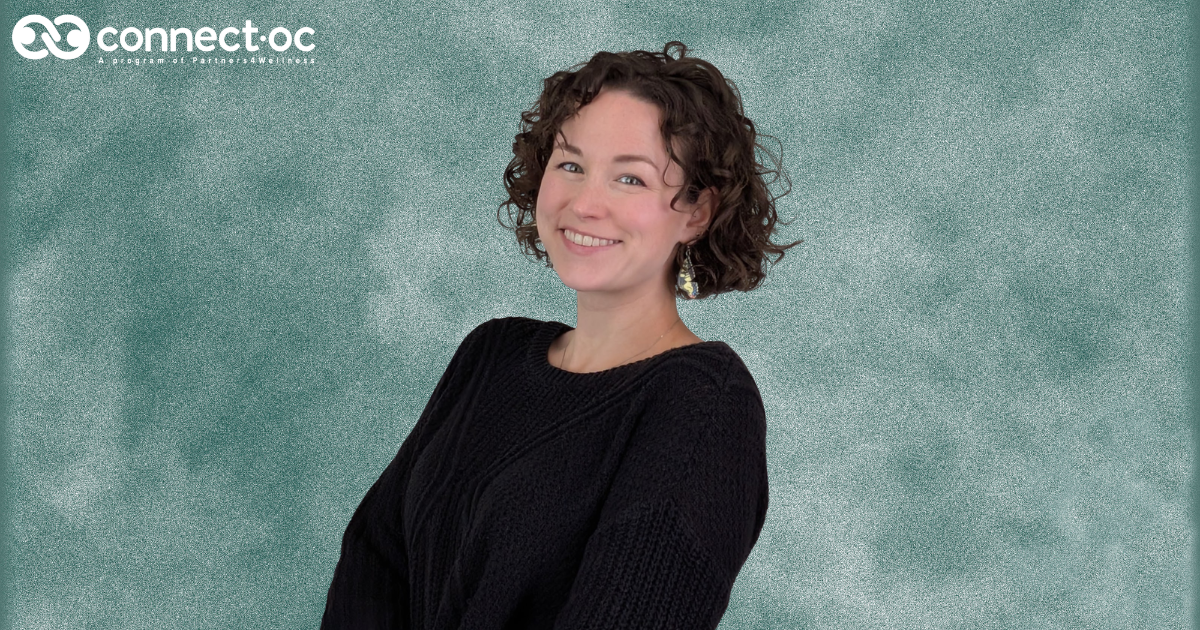
Tell us a little about yourself…
My name is Christina Mott Myers, and I have been a teaching artist doing cultural arts outreach workshops through the Mindful Expressions program since 2021, which was before we were even a part of Partners4Wellness/Connect OC! I had experience both as a working artist and as an arts instructor before that, and will be starting a graduate program at Loyola Marymount in September to begin training to become a licensed Art Therapist and Marriage and Family Therapist. I currently live in the northwesternmost corner of Huntington Beach, with my husband and our two cats.
What is your connection to Orange County?
My family moved to South Orange County while I was in elementary school, so I lived there until I graduated high school. I moved out to go to college at CSULB, then lived in Long Beach for around 15 years until my husband convinced me we should move to Huntington Beach to be closer to the surf. Through the art workshops, I have been traveling all over the county to work in various partner programs, and getting to appreciate all the diverse corners and vibrant communities of this big county.
Share a little bit of your outlook on life…
There is a lot of hardship in life, but also a lot of beauty. I try to find humor and joy in as many places as possible, and believe we’re alive to have the pleasure of getting to know ourselves, each other, and the universe in which we live. There’s so much to see, learn, and appreciate if we keep an open mind and an open heart. Each person has a unique, invaluable perspective to contribute to our shared experience of being human, and everyone deserves an opportunity to explore connections with themselves and with the world around them. That’s why I love sharing art with people–it’s play, it’s exploration, and it’s a unique expression that only YOU can share with the world! Even when I lead a group through a guided painting where we all follow the same steps with the same subject, each piece is so charmingly unique–even if the artist themselves doesn’t think it’s “good,” I think it’s great to see their piece because I’ll never see another one exactly like it. When a workshop involves a little less specific direction, I absolutely love to see how each person interprets the prompt and chooses to use the materials. Humans are such creative beings!
What is your favorite book?
Based on the number of copies I’ve purchased and given away as gifts, I guess I have to say it’s Your Illustrated Guide to Becoming One With the Universe by Yumi Sakugawa. It’s short, but impactful. Definitely recommend for anyone interested in unlocking some cosmic inner wisdom while enjoying playful, dreamlike illustrations. I also love reading novels; some surreal/existential/philosophical sci-fi titles that have made an impact recently include Toward Eternity by Anton Hur and I Who Have Never Known Men, by Jacqueline Harpman. My favorite way to read or listen is through the Libby app–support your local libraries!
What is your favorite self-care activity?
I love taking a walk to move my body and clear my mind, and try to notice little moments of beauty while being outside. Bonus points if it’s someplace scenic like the beach, the wetlands, or a hike through the woods.
What drew you to being involved with community mental health work or advocacy?
I have always had a personal interest in psychology and mental health; it was a focus of my MFA thesis, actually. When I was introduced to Erin (my wonderful manager who established the Mindful Expressions program) and learned about the purpose of the workshops, I was really excited to be a part of it. I truly believe that the opportunity to engage in creative expression is something every person deserves access to, and I love being able to help facilitate the self-exploration and community building that happens when we come together and make art.
What is your preferred art medium (for example: writing, drawing, painting, graphic design, etc.)?
Anything mixed media and visual arts; I kind of missed the memo in school that we’re supposed to specialize. I probably have the strongest foundation with drawing, but also love a good unpredictable paint/ink layer, and have dabbled in experimental animation as well. Collage is fun because it’s like solving a puzzle without knowing the end image in advance. If you give me clay or plasticine (or even a chunk of old surf wax), I will spend hours sculpting tiny details.
What drew you to your preferred art medium?
I have a pretty eclectic approach to art making, and love trying new things and finding ways to combine different media to express an idea or just experiment and see what happens. After years of training classically and honing my rendering skills, I had the realization that often what I enjoy most is what happens when I’m not controlling or overthinking it, so now I embrace the unexpected.
What role have the arts played in your life, especially your mental health?
I have always been drawn to the arts, and have been identified by others as an artist for about as long as I can remember. As a kid, I definitely had a hard time with a lot of things, from socialization to emotional regulation to paying attention in school, and art was always there for me. It was in the margins of my notes, on the backs of my tests, and on the sides of my shoes. It was a way of mental escape, a way of self expression, and a way to connect with peers. It was as many electives as I could fit into my schedule in high school, the main focus of any summer program I might attend, and the most obvious choice for a college major (even though there were other things I considered and am interested in, it seemed like the only option I could sustain effort in for four years). It has also been a contributor to some mental health challenges, if we’re honest; I did not always enjoy working as a commercial artist, for a variety of reasons. I struggle sometimes even now without keeping up with my personal practice, but when I do make time for my own creative activities I generally feel better regulated and more like “me.” In my role as a teaching artist, I feel truly honored to be able to facilitate access to creative outlets for others in my community, and to witness each participant’s unique expression.
Can you share a bit about your involvement with the Cultural Art and Mental Health Workshops provided by Partners4Wellness and Connect-OC?
Our workshops have been steadily gaining popularity as we continue to build and strengthen relationships with our community partners, and it has been great to have the infrastructure and support since teaming up with Partners4Wellness and Connect-OC two years ago! My role is to plan and host visual arts workshops which incorporate mental health themes and exercises for groups at partner sites around the county. These can include drawing, painting, sculpture, collage, and more; typically we start with some breathing regulation exercises before going into some reflection questions or discussing a theme, and then we start making art! I bring all the materials and set everything up before participants arrive, and I really love being able to offer that experience for people, and hearing how they feel after the workshop as well.
What have been some of your favorite cultural art workshops to lead?
It’s hard to pick favorites–each group offers unique qualities and it’s almost always a good time. I especially enjoy working with the same participants on an ongoing basis, since getting to know the group helps us all feel more comfortable opening up with each other, and makes it easier for me to plan activities and themes I think will be the most impactful. I do always love pushing people to “act and react” and create expressive abstract mixed media works without necessarily having an end goal in mind–I think it’s a great challenge especially for people who tend to get stuck in their heads. Another one of my favorite materials is air dry clay, which tends to be a participant favorite too. It kind of demands your full attention; both hands, full sensory involvement, and 3D consideration while you work your way from a gradual shape to specific details. It also affords a lot of opportunities to discuss frustration, and practice starting over, when things don’t materialize exactly as we envision on the first try.
What ways have you seen art in regards to reducing the stigma surrounding mental health?
Making art is a vulnerable activity. A lot of people express hesitation because it feels uncomfortable to try something we’re not sure we’re “good at,” or to express ideas we aren’t entirely sure of, or show our work when feeling afraid it’ll never be “perfect.” I think it’s a great way to practice pushing ourselves outside of a comfort zone in a safe space that’s actually pretty low stakes at the end of the day. We get so used to feeling like we need to do things a certain way, but there’s not really a wrong way to make art as long as you’re staying open to the experience. It also opens up a lot of conversations as we go through the process, because people do tend to relax into the activity and find ways to relate together about what they’re feeling as we go through the process, and how it relates to what they’re going through in life at the moment. Coming together in a group to try something new, taking a chance to experiment and play, and also reflecting and sharing thoughts on the mental health themes are all ways to build community and connection with other people at the table. People also tell me they take activities and ideas home to their families and friends, too, which I love to hear. Usually we have a good time, but it’s also always okay to not be okay. No one has to pretend they’re having fun if something big is going on, and every time that happens I see the group rally around the person struggling, whether it’s empathetic listening or sharing a similar experience and a perspective or advice they’ve learned from it. I think the more we normalize conversations around mental health, and also practice letting ourselves be seen by others, the less alone we feel and the more empowered we become to seek help when it’s necessary.
Can you share a bit about your recent involvement with the Stop the Hate campaign and Art Exhibition?
That was a really special series of workshops, at a wonderful and welcoming community center. The Cambodian Family in Santa Ana has a mission “to promote social health by providing refugee and immigrant families the opportunities to develop the knowledge, skills, and desires for creating health and well-being in their lives.” This was actually the second year our program has helped with the Stop the Hate campaign, but my first year as the teaching artist leading these workshops. We wanted to provide an opportunity for the elders of the community to tell their stories and share their visions of hope through artwork to be displayed in a gallery during the annual Cambodian New Year celebration event. At first, it was clear that some people had not painted in a very long time, if ever! With the indispensable help of the amazing TCF staff providing translation services and hands-on assistance in the classrooms (it was a large group of up to 40 people), we went from confusion over color wheels, through several guided paintings, to completed original artworks over a series of seven workshops. Even with a language barrier, the participants made me feel so welcomed and appreciated, generously sharing fruit and flowers from their gardens, inviting me to share meals, and greeting me with such happy faces every time. The gallery turned out gorgeous, with their artwork lovingly displayed alongside beautiful textiles and artwork from Cambodia, and we had a great turnout of community members for the event which also featured dance performances, a resource fair, and a bountiful potluck buffet for lunch.
Can you share a bit about your ambition to become an Art Therapist and the Art Therapist Graduate Program at Loyola Marymount?
It has been a fairly common misunderstanding that because I am leading art workshops with a mental health component, I must be an Art Therapist/offering Art Therapy, but that’s not exactly the case! While a lot of people do find it therapeutic to engage in the arts, and we are definitely leveraging the mental health benefits of creative expression, Art Therapy is actually its own therapeutic modality which requires specialized mental health training just like any other licensed profession (e.g. social work, counseling, or marriage and family therapy). I really enjoy being able to connect with people through the art workshops in our program, but believe I’ll be an even more effective supporter of mental health as a trained professional. To be honest, I didn’t really realize there was a profession that combines Art and Mental Health in this way until recently, but I think I needed to go through the life and experiences I’ve had so far to be ready for this next stage of the journey, anyway. After a long and challenging application process, I am very excited to say I will be attending Loyola Marymount University's graduate program in Marital and Family Therapy with specialized training in Art Therapy starting in September 2026! This program integrates visual arts and psychotherapeutic skills to prepare students to become licensed marital and family therapists in the state of California, and nationally-registered art therapists through the ATCB. I’m really excited to learn a lot through the program, and continue working at this intersection of art and mental health as a therapist after my training is complete. For more information about Art Therapy, visit the American Art Therapy Association website at https://arttherapy.org/
What would you share with a young adult that may be struggling with their mental health?
First, it’s normal to struggle, especially with all the transitions and uncertainty that are unavoidable as we enter adulthood. Life is hard, and you’re doing this for the first time–be easy on yourself while you learn. Second, you are never alone, even if it feels like you’re the only one in this exact shade of struggle at the moment, someone can probably relate more than you can imagine. It usually feels heaviest to carry it alone, even if it seems impossible to open up about whatever it is. There are people in your life who want to help, and there are professionals available when it’s time to outsource–therapy is for everyone! I know it can feel like a lot to find a good match, but it’s so worth it for the support and skills you can gain. OC Navigator has all kinds of resources from mental wellness and substance abuse, to housing and legal help for whatever is going on (https://ocnavigator.org/m/ocn). 988 is a crisis hotline you can call or text for immediate, 24/7 help for yourself or a loved one (https://www.988california.org/)
Why do you think youth/young adults should attend community mental health events and cultural art workshops, like those hosted by Connect-OC?
It’s important to normalize conversations about mental health, and a great opportunity to feel present in your community. It’s also important to break out of normal routines and try new things, for personal growth and also just for fun. Worst case scenario: you don’t like it and never have to go back. Best case scenario: you enjoy the activity, make connections in the group, and learn a little bit about yourself and about resources available in your community. A lot of people leave workshops saying how they feel lighter, more relaxed, or maybe a little surprised at how much they enjoyed the activity and the art they’re taking home. Some even rediscover a core part of themselves, and will tell me months later about the journal or sketchbook they started keeping, or the painting corner they have at home now. Even if that doesn’t happen, you’ll be happy you tried something new, and maybe feel a little braver next time an opportunity comes along to put yourself out there.
Categories
Subscribe to receive updates
Blog RSS Feed